
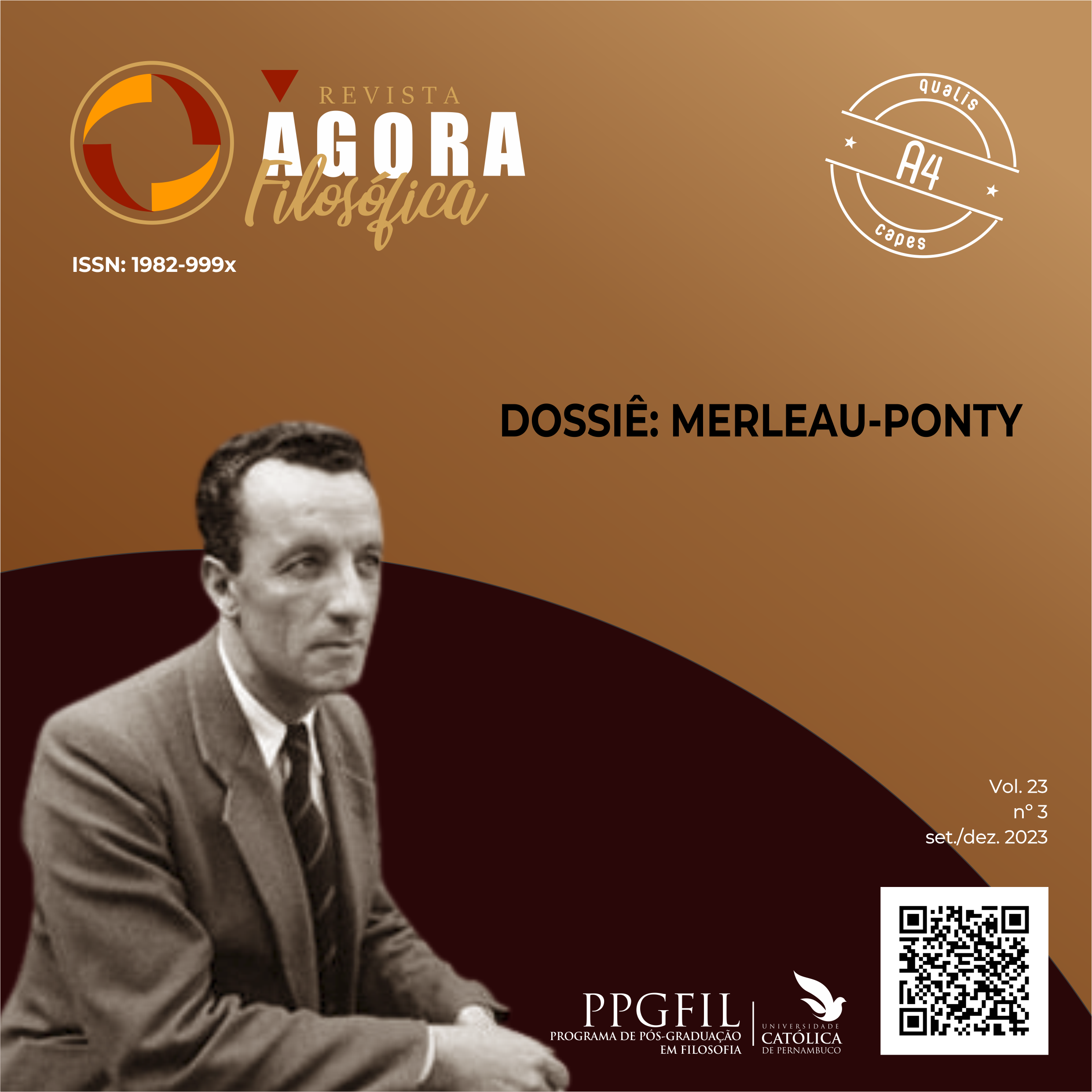
Paul Claudel, Maurice Merleau-Ponty and temporality
DOI:
https://doi.org/10.25247/P1982-999X.2023.v23n3.p61-80Keywords:
Claudel, Merleau-Ponty, literature, philosophy, temporalityAbstract
This paper deals with the notion of time in the thought of the poet Paul Claudel and of the philosopher Maurice Merleau-Ponty. It does not merely aim to present the two conceptions of time, rather to understand Claudel's notion of time and identify its possible relations with the notion of time in Merleau-Ponty. In the first place, therefore, this work presents the Claudelian concept of time in Art Poétique, so that, then, the possible relations between the poet and the philosopher about temporality can then be explored. It will help, to understand the crucial role Claudel played in Merleau-Ponty’s philosophical project.
Downloads
References
ANGERS, P Commentaire à l ’ Poétique Paris: Mercure de France 1949.
CLAUDEL, P. Art Poétique Paris: Gallimard 1984.
MERLEAU PONTY, M. Fenomenologia da Percep ção Trad. Carlos Alberto Ribeiro de Moura. São Paulo: Editora Martins Fontes, 2011.
MERLEAUPONTY, M. Notes de cours (1959 1961) Paris: Éditio ns Gallimard 1996.
MERLEAU PONTY, M. O Visível e o Invisível Tradução: Jos é Artur Gianotti; Armando Mora d Oliveira. São Paulo: Perspectiva, 2014.
Downloads
Published
Issue
Section
License
Copyright (c) 2023 Cleiton Nery de Santana

This work is licensed under a Creative Commons Attribution 4.0 International License.
This work is licensed under a Creative Commons Attribution 4.0 International License.
Authors publishing in this journal agree to the following terms:
- Authors retain copyright and grant Ágora Filosófica the right of first publication, with the work simultaneously licensed under the Creative Commons Attribution License, which allows the work to be shared with acknowledgment of authorship and initial publication in this journal.
- Authors are authorized to enter into additional agreements separately for the non-exclusive distribution of the version of the work published in this journal (e.g., publishing in an institutional repository or as a book chapter), provided that they acknowledge and indicate the authorship and initial publication in this journal.
- Authors are permitted and encouraged to publish and distribute their work online (e.g., in institutional repositories or on their personal websites) at any time after the completion of the entire editorial process, as this can generate productive changes, as well as increase the impact and citation of the published work (See The Effect of Open Access).